Journal
Whose Home Is It?
Frieze Seoul 2026
Media art is one thing. But where did all the photography go?
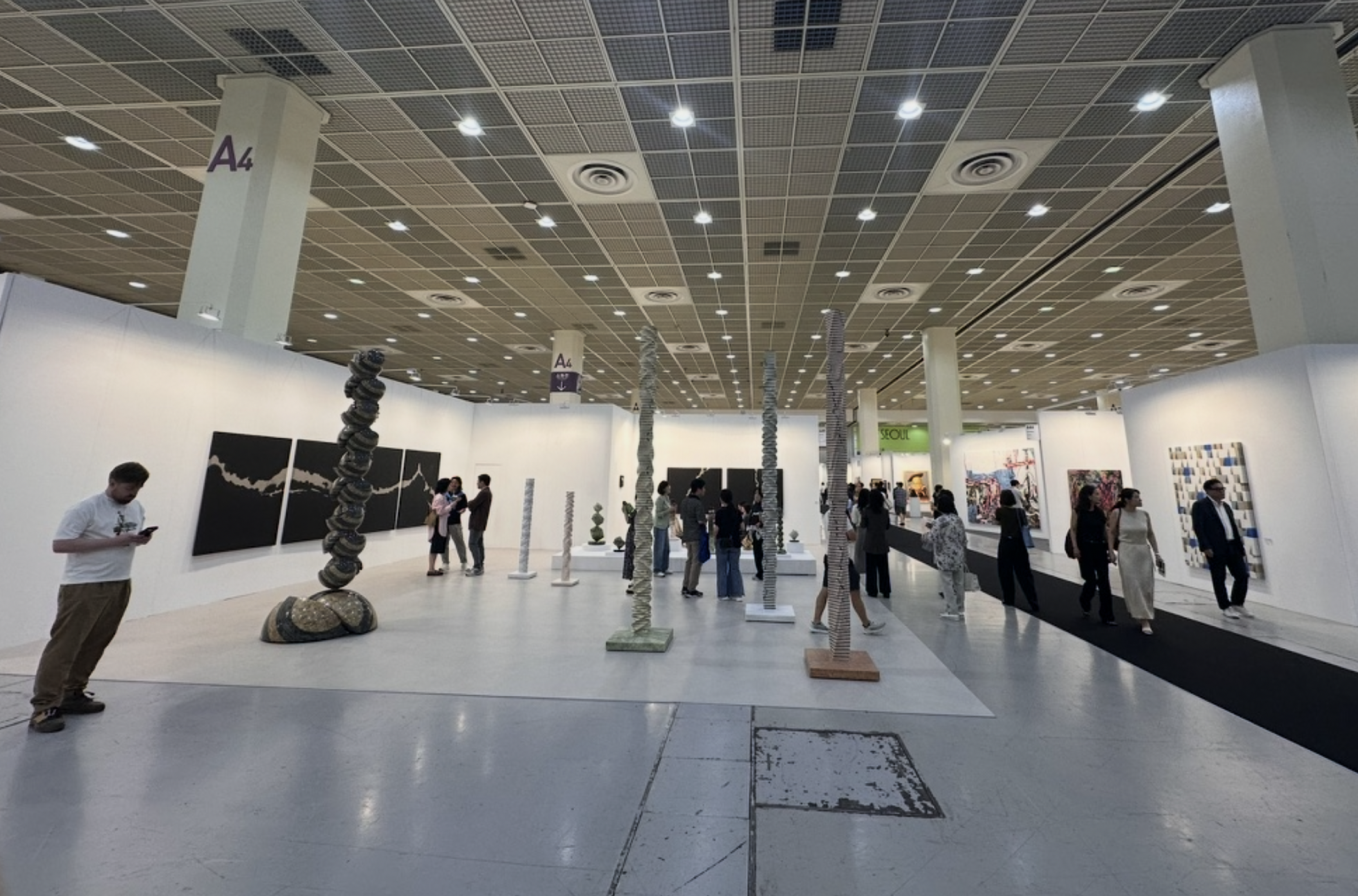
That was one of my first thoughts walking through Frieze Seoul 2026. In a fair overwhelmingly dominated by painting, photography and media art felt surprisingly scarce. They hadn’t disappeared entirely, of course. If anything, that made the occasional encounter — such as the photographs of Youngsoo Han — stand out even more.
Now in its fifth edition, Frieze Seoul brought together 133 galleries from 30 countries and territories. More than 70 percent of the participating galleries are based in the Asia-Pacific region, while over 50 have a permanent space in Seoul.
First, Finding Your Way
There is a problem I run into at almost every art fair: where do you begin?
Rows of gallery booths stretch along the aisles, punctuated by curated sections with their own distinct focus. Using these sections as landmarks makes the fair a little easier to navigate. This year there were three: Focus, Material Practice, and Spotlight. Focus presents younger galleries and emerging artists; Material Practice looks at materials and processes; and Spotlight revisits artists who have received less attention within established narratives of 20th-century art.
Material Practice was curated by Hyeyoung Cho, Spotlight by Wonseok Koh, while Seolhui Lee served as advisor to Focus. Of the three, I spent most of my time in Focus and Spotlight.
Tearing Down the Wall — Yagwang
Near the entrance, visitors encountered Yagwang’s Facade Zone (2026), winner of the Frieze Seoul Artist Award.
Yagwang is a Seoul-based artist collective formed by Terri Kim and In Jeon. For Facade Zone (2026), they dismantled the temporary partition walls of an art fair booth and rebuilt them as an exposed wooden framework. Inside, they combined latex sculptures based on guardian figures from Korean Buddhist iconography with a lighting structure.
What makes the work interesting is that instead of simply presenting something inside the fair, it exposes the very apparatus the fair uses to present art.
Walls exist to hold artworks, but we rarely look at the walls themselves. Yagwang simply tears them open.
Focus — From Asia to the World
This year, Focus expanded beyond its previous emphasis on Asia to include galleries from Europe and the Americas. The section was advised by Seolhui Lee, Senior Curator and Head of Creative Partnership at MAPS — Museum of Art in Public Space in Denmark.
Sixteen young galleries established since 2014 each presented a solo presentation by one artist. Alongside galleries from Seoul, Tokyo, Osaka, and Shanghai were participants from London, Paris, Rome, Stockholm, Budapest, New York, and São Paulo.
The place where I lingered longest was Seoul’s Whistle.
Its presentation of dpgp78 was fun. The duo, Jihwan Kim and Seongsik Min, covered around 500 small sponge blocks with drawings and words, filling shelves and garlands with them.
Scribble-like drawings, symbols, and odd bits of language appear everywhere, and part of the pleasure is looking at them one by one. Visitors can pick up and handle the blocks they are drawn to, while the process of choosing and buying a work becomes part of the piece itself.
Two that caught my eye read “Detox Juice” and “Chihuahua Day.”
At first, it all feels light and playful. But the longer you look, the more questions begin to surface.
Does a painting have to hang on a wall?
Are we looking at art, or consuming it?
Spotlight — And Finally, Photography
Introduced to Frieze Seoul for the first time this year, Spotlight was curated by Wonseok Koh, Director of the Line Cultural Foundation. The section revisits artists who have remained relatively overlooked outside the established canon of 20th-century art.
The artist who caught my attention most was Youngsoo Han (1933–1999), presented by BAIK ART.
When we think of Seoul after the Korean War, images of ruins and poverty often come first. Han’s photographs offer a different view. People skate on the frozen Han River; children cut round holes through the ice to fish. Alongside the traces of war, his photographs capture the vitality of people rebuilding everyday life and the emergence of a modern city.
And Then, Inevitably, the Numbers
Move into the main gallery section and another landscape emerges.
Gagosian, Hauser & Wirth, White Cube, Thaddaeus Ropac, Pace, and David Zwirner are among the global mega-galleries on the floor, and alongside the language of art, prices and sales create another narrative of the fair.
It is an art fair, after all. So here, the numbers can speak for themselves.
Frieze Seoul 2026 — Selected Reported Sales
| Gallery | Artist | Work | Reported Price |
|---|---|---|---|
| Kukje Gallery | Yoo Youngkuk | Work (1971) | KRW 2.2–2.5B |
| Thaddaeus Ropac | Adrian Ghenie | Figure with Funerary Stele (2026) | €1.1M / approx. $1.28M |
| Thaddaeus Ropac | Antony Gormley | HOLD (2024) | £750,000 / approx. $1M |
| White Cube | Gerhard Richter | Fuji | €625,000 / approx. $724,000 |
| Hauser & Wirth | Louise Bourgeois | Femme | $600,000 |
| Hauser & Wirth | Lorna Simpson | End of Twilight | $425,000 |
| Hauser & Wirth | Lorna Simpson | Perceived Sound | $400,000 |
| White Cube | Park Seo-bo | Ecriture No.221121 | $300,000 |
| Sprüth Magers | Cyprien Gaillard | Life in the cracks (Part 2) (2025) | €200,000 / approx. $232,000 |
| Thaddaeus Ropac | Alex Katz | Study for Emma (2015) | $150,000 |
Among the Frieze Seoul 2026 sales reported so far, the highest-priced work was Yoo Youngkuk’s Work (1971), presented by Kukje Gallery. According to the gallery, it sold for between KRW 2.2 and 2.5 billion to a board member of a North American museum.
Of course, publicly reported prices do not tell the whole story. Galleries differ in how much sales information they disclose, and many transactions remain private. The figures above represent only the deals that have made their way into public view.
Still, numbers are hard to avoid at an art fair. Works are shown, priced, and sold — and the sales themselves become news.
Yet what stayed with me after leaving the fair were other things: Youngsoo Han’s photographs, the wall Yagwang tore apart, the small sponge blocks of dpgp78.
And then I thought again of Wonwoo Lee’s HONEY I’M HOME (2026), which I had encountered at PKM Gallery. Its mirror-like metal surface reflected the people looking at the work, along with the art fair unfolding around them.
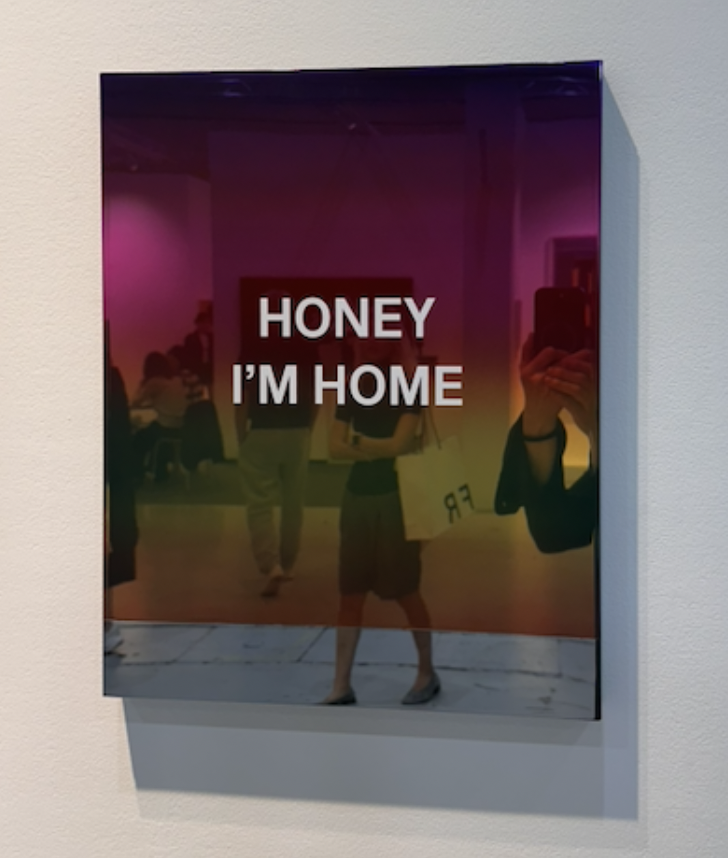
HONEY I’M HOME.